Barnaby Smith on LIVE From London, VOCES8 Records and making music go further
The LIVE From London festival began as a way to bring concerts to audiences during the pandemic. VOCES8 Records had an even more unexpected start, involving a Christmas single and the collapse of the high street retailer Woolworths. Barnaby Smith explains how both projects have developed and how they now help other musicians reach new fans.
When Barnaby Smith first imagined broadcasting a VOCES8 concert online, he had a relatively modest setup in mind: a camera plugged into a computer, supported by the audio equipment already installed at the VOCES8 Centre in London.
It was 2020, the pandemic had brought live performance to a halt, and musicians were looking for ways to reach audiences confined to their homes. VOCES8 had an advantage: its own venue, already equipped for sound recording. The question was how to add pictures.
‘I have to be honest,’ says Smith, artistic director of VOCES8 and the VOCES8 Foundation. ‘When I first came up with the idea, I was expecting just to put one camera, almost like a web camera, plugged into a computer, with our nice sound rig.’
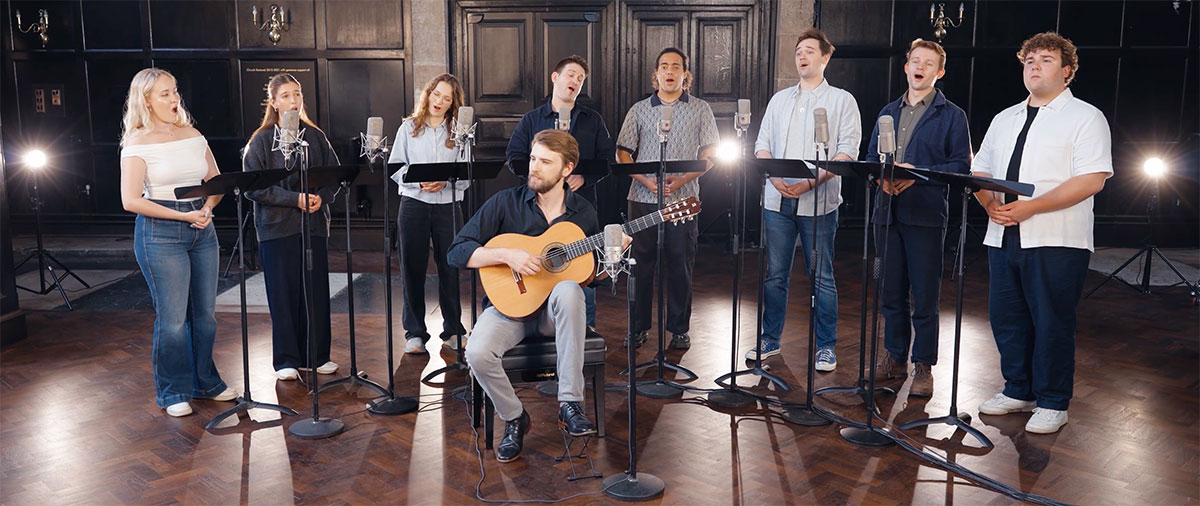
Smith recalls that around 5,000 tickets were sold for the first LIVE From London festival. The response encouraged him to think bigger: he spent the following months researching cameras and technology, eventually equipping the venue as a film studio. The result was an online festival bringing together VOCES8 and other artists at a time when conventional concerts were impossible.
The first broadcasts were genuinely live, with performers brought into the VOCES8 Centre under the restrictions then in force. For groups that had not sung or played together for months, performing two metres apart presented its own challenges. The technology was not without difficulties either.
Despite investment in a dedicated internet connection, the first stream failed partway through the concert. Smith remembers being summoned to the control room by his brother Paul’s voice over the talkback system. After around ten minutes, the connection was restored and he returned to apologise to the audience.
Everyone was doing their best under extraordinary circumstances, he says. More than six years later, the festival is still running.
A festival born in lockdown
For Smith, one of the pleasures of LIVE From London was the opportunity to work with fellow musicians who would normally have been travelling in different directions.
‘In our little sphere, most people tour, so it’s very unusual that you have artists in the same place at once,’ he says. Some of the collaborations formed during the pandemic have continued in the years since.
Audiences remember the experience too. Smith still meets people after VOCES8 concerts who first discovered the group through LIVE From London and who tell him how much it meant to have access to music during lockdown.
Now approaching its 20th edition, the festival has adapted to a world in which musicians are once again touring. There are usually summer and Christmas festivals, with an Easter edition when programmes and schedules allow.
The format has changed. While the first concerts were broadcast live, performances are now generally recorded in advance, often as live performances, and made available to watch during the festival. This makes it easier to accommodate artists’ touring commitments and gives audiences the flexibility to watch when it suits them.
There is still an opportunity to watch in company. Some seasons include online ‘watch parties’, where performers and audience members meet for a conversation before starting a concert together, followed by a question-and-answer session.
Much of the filming takes place at the VOCES8 Centre, but the team also works elsewhere. One approach is to film an existing public concert and then make it available to the online festival audience. VOCES8’s forthcoming Christmas concert at St Martin-in-the-Fields, for example, is due to be filmed for LIVE From London.
‘Recorded live now rather than broadcast live,’ is how Smith sums up the distinction.
Life after the festival
Festival concerts are normally available for a defined period, with viewers able to watch more than once. Some past performances return in later editions, while other material appears on VOCES8’s YouTube channel or its YouTube membership service.
Making the archive more widely available is not simply a matter of uploading the films, however. The Foundation must consider both the rights of the artists and the copyright in the music performed.
Smith points to a performance of JS Bach’s Mass in B minor, first presented in 2021 and subsequently brought back for another festival. With soloists, orchestra and a large number of other musicians involved, releasing the performance freely online would require agreements that recognise their rights and provide appropriate payment.
‘If the world was made of chocolate, I would just have a library online where people subscribe and go and watch this stuff,’ he says. ‘It’s just so nice looking back at what we were doing five, six years ago.’
For the moment, each potential release has to be considered on its own terms.
Sharing the stage and the proceeds
LIVE From London includes the Foundation’s own ensembles, among them VOCES8, APOLLO5, Lyyra and the VOCES8 Scholars, alongside established guest artists and emerging groups.
Programming is a combination of planning and opportunity. Artists may already have a concert or recording project under way; the festival team then looks at how those performances fit together and where a contrasting programme might be welcome.
Smith likens the process to the television programme Ready Steady Cook: given a selection of ingredients, the task is to make a satisfying meal. For the forthcoming Christmas season, the team decided to add the Salvation Army to a programme already rich in choral music, bringing a different musical tradition into the mix.
The festival’s financial model is cooperative. Generally, Smith explains, the artist provides the performers, while the VOCES8 Foundation supplies the filming, editing and marketing. Income is then split equally.
‘If a season sells particularly well, the artist does well,’ he says. The arrangement also gives participating groups an incentive to promote the festival to their own followers.
Asked whether there are other festivals with the same structure, Smith says he does not know of another working in quite the same cooperative way, although many organisations film and broadcast concerts. He believes that bringing artists and audiences together benefits everyone involved.
‘It’s never about growing your slice of the pie, it’s always about growing the pie itself,’ he says. ‘If the pie gets bigger, everyone’s slice gets bigger.’
The team works with groups it already knows, musicians it admires and artists who have introduced themselves. Unsolicited approaches are therefore welcome, although relationships and recommendations remain important in a relatively close-knit sector.
Helping an ensemble find its feet
One group benefiting from that approach is The Mancunium Consort, which is appearing in the forthcoming LIVE From London season. The ensemble was founded jointly by a former VOCES8 Scholar and a member of APOLLO5, giving it a connection to the Foundation.
Over the past year or two, Smith says, the Foundation has helped the ensemble develop its profile through recordings, video and LIVE From London. He has also worked with its artistic director, Harry, on music technology skills.
The support can extend beyond the artistic side: introductions to agents and help with public relations are part of the process. Smith agrees that there is something of a business incubator about the relationship.
The Foundation’s own groups are an important attraction for audiences, but the festival also looks for artists who complement and contrast with them, giving listeners a reason to discover something new.
Smith estimates that a current festival concert might sell around 1,000 tickets. A ticket does not necessarily represent a single viewer: couples, families or groups may watch together, sometimes more than once. It is difficult to know precisely how many people are reached, but the audience for a filmed concert can be considerably larger than the ticket figure alone suggests.
Broadcasting from further afield
Smith can see possibilities for taking the festival to other places. LIVE From London has already worked with the American ensemble Chanticleer in San Francisco, and he would welcome more projects in different parts of the world.
His ambition would be to return to live broadcasting, perhaps building events around VOCES8’s touring schedule and presenting concerts from cities such as London, Berlin, New York, Sydney or Hong Kong, with other performances alongside them.
There are practical obstacles. High-quality filming requires expensive equipment and skilled operators; outside a venue such as the VOCES8 Centre, those costs can rise quickly. Some concert halls have their own facilities, but the economics would need careful consideration.
Cinema broadcasts are another possibility. Smith says LIVE From London has not yet taken that route, but the idea appeals to him, even if he is less certain about seeing his own ‘singing face’ on a very large screen.
A Christmas single and the collapse of Woolworths
If LIVE From London began with a lockdown experiment, VOCES8 Records has a rather different origin story, involving a television theme tune, a Christmas single and the collapse of Woolworths.
In 2008, songwriter Ken Howard approached the group with an idea based on his theme for the television series Miss Marple. He had set it to the story of a chorister at Christmas and hoped to make a bid for the Christmas number one.
Rather than hand the rights to an existing label, Howard helped secure a distribution deal, and the group established its own label, then called VCM Records. The initials came from Voces Cantabiles Music, the name of the company associated with the larger choir from which VOCES8 had emerged.
The project appeared promising, with several thousand copies pre-sold. Then Woolworths, the high street retailer through which distribution was being handled, collapsed. Smith recalls that around £20,000 of stock was lost in the liquidation: a serious blow for a young musical organisation.
The label continued in the background for some years. VOCES8 subsequently signed with Decca Classics, a relationship that continues. But the group also wanted an outlet for recordings aimed more directly at its concert audience, including core repertoire and recital-style albums. An agreement with Decca allowed VOCES8 to develop those releases through its own label alongside its work with the major label.
The next step was to open the door to other artists.
A label for other artists
Some musicians were already coming to the Foundation for help with recording. The label offered a possible route for releasing the finished work, with promotion supported by the Foundation’s team and VOCES8’s existing audience.
Smith says the label aims for a 50-50 arrangement with artists. The intention is to offer what he describes as ‘a fair and affordable way for artists to get their music into the marketplace’.
There can also be value in being associated with an established name. Smith remembers that when VOCES8 was starting out, the group wanted to be on Signum Classics because of its association with artists including The King’s Singers and The Swingles. An emerging artist joining VOCES8 Records may find a similar benefit in reaching listeners who already follow the group.
The label’s focus is broadly choral, but Smith does not see that as a rigid boundary. Solo singers feature among its artists, and he is interested in projects connected to the wider musical world around choral performance. He mentions a conversation with an organist about recording Bach keyboard music arranged for organ.
Artists approach the label regularly, sometimes after hearing about another group’s experience. Smith says the Foundation is happy to hear from musicians who would like to discuss a project.
‘Video is the new CD’
For an ensemble seeking to build an audience, a recording can have a purpose beyond direct sales. Smith is candid about the economics.
‘We make albums not really to make money, we make albums to market ourselves,’ he says.
In his experience, video has become particularly important. YouTube is VOCES8’s largest platform, and he believes it plays a major part in bringing people to the group’s concerts. Some listeners watch a performance initially, then return to it as part of a playlist, using the video platform much as they might use an audio streaming service.
‘I would say that video is the new CD,’ he says.
The Foundation encourages artists recording for the label to make video alongside their audio recordings and can help with filming. Physical formats still have a place, especially at concerts, where a CD can be a souvenir of the evening. Smith says VOCES8 might sell 30, 40 or 50 CDs after a concert, as well as ten or more vinyl records. He has noticed renewed interest in vinyl, although physical sales overall are much lower than they once were.
New music and publishing
The Foundation’s work with artists extends to composers. VOCES8 works with a composer in residence and commissioned ten new choral works for its 20th anniversary. It also hears from composers who send scores directly to the group.
A new piece might be recorded, shared on YouTube and potentially published through the Foundation’s publishing operation or its American partnership with ECS Publishing. Smith estimates that VOCES8 engages with around four or five new works each year, whether through direct commissions or music brought to the group by composers.
The publishing arm is being developed further. Work on the catalogue and website is intended to make it easier for choirs to find music suited to their forces, using categories such as voice parts and accompaniment.
Smith would also like to make more of VOCES8’s pop and jazz arrangements available to choirs, although licensing makes that more complicated. The team is working on ways to do this through commercial publishers.
Looking ahead
Smith describes LIVE From London and VOCES8 Records as planets orbiting a sun. At the centre are the Foundation’s performing ensembles, whose concert fees provide much of its income. The surrounding activities support that work and one another: performances generate material for films; films introduce artists to new audiences; and those audiences may then buy tickets for concerts.
Fundraising and other activities also contribute to the Foundation’s finances, but the value of the festival and the label, he says, cannot be measured solely by the income they generate in their own right.
In future, the Foundation hopes to do more of its own concert promotion, taking on greater financial risk but also the possibility of greater returns. A concert presented by VOCES8 in a major venue could, in turn, be filmed for LIVE From London or recorded for release.
Smith is cautious about making fixed predictions for the festival or the label. The market is changing, he says, and the Foundation will continue to respond to opportunities as they arise.
What began as a way for VOCES8 to record and broadcast its own music has also become a means of helping other artists do the same. For Smith, that is a natural part of the Foundation’s work.
‘We are a charity, and so all we’re trying to do is support musicians,’ he says. ‘We just leave the door open.’
Barnaby Smith
Barnaby Smith is a Grammy-nominated conductor, countertenor and producer, and Artistic Director of VOCES8, the VOCES8 Foundation and the LIVE From London digital festivals. His work spans international performance, recording and education, with the Foundation’s programmes reaching tens of thousands of participants annually and LIVE From London attracting audiences in more than 180 countries.
He has conducted leading orchestras including the Philharmonia and London Philharmonic, while his solo recordings of Handel and Bach have received critical acclaim. Alongside his performing career, he directs the Milton Abbey International Summer School and produces VOCES8’s recordings and films. He began singing as a treble at Westminster Abbey before studying early music at the Schola Cantorum Basiliensis.